

There was Ferdinand I (1532-1564), Maximilian II (1564-1576), Rudolf II (1576-1611), and then came Matthias (1611-1619). One could say: “the king is dead, long live the king”.
We have reached the years when the inhabitants of Folwark regained personal freedom. From unfree people, bound to the land, they became free. In various sources you can find that this was the year 1534, the settlement of the village of Forwerckh under German law. But we must remember that such a historic fact, the change from unfree to free, is not a matter of one year but a process that took several years. So the date 1534 is not what matters most here; what matters is that it happened. And it happened, because entries in the castle urbaria of 1566 confirm it. The inhabitants, now free, could lease land belonging to the ducal lord, as in the first years they certainly did not have the “ducats or thalers” to buy it.
But someone still had to farm and work the lord's land, and the ruler, the emperor, knew this, so bondage was replaced by serf labour and various compulsory dues. On 24 March 1562 Ferdinand I issued an edict, the law on serf labour in the Duchy of Opole and Racibórz, where we read:
My Ferdynand z Bozi milosti woleny rzimsky czysarz po wsseczky cziasy rozmnozitel Rzisse a vhersky, cziesky, dalmatsky, charwatsky ect. kral, inffant w Hysspany, arczy knizie rakauzska, margrabie morawske, luccemburske a slezke knizie, a luoziczke margrabie etc...
We, Ferdinand I, by the will and grace of God Roman Emperor and of the German Reich for all time, of the Bohemian, Dalmatian and Croatian lands, Infante of Spain, Archduke, Margrave of Moravia, Luxembourg and Silesia and Margrave of Lusatia, etc. ... Then we read about the duties of the imperial commissioners appointed to watch over the peasants, whose obligations are described in the same edict.
The obligations described changed the lot of Silesia's inhabitants little in essence, and the owners, that is our nobility, were in no hurry to observe the new law granted to the peasants. There were revolts, of course bloodily suppressed. A separate subject that emerged in these years was the new teachings of Luther, the Protestants. Everything that happened in the Habsburg state also happened in our Opole, from where it radiated out to Folwark.
The teachings of Martin Luther (from 1518) reached the town of Opole in the time of the last Piast, Duke Jan II the Good (1497-1532) at Opole castle, and the Dominican monastery emptied. After his death in 1532, or rather after the plundering of the treasures amassed in the castle (of Jan II) by Ferdinand II, rule in Opole was taken over by Georg von Hohenzollern (an inheritance from Jan the Good). The inhabitants, taking advantage of the privileges granted by him, Georg, turned in large numbers to the new religion. After his death (1543), Isabella Zapolya became Queen of Opole, reaching Opole from Transylvania on 8 March 1552. In 1554 she officially issued a ban on engaging preachers of the new religion, but in reality she was favourable to the new movement.
Later Ferdinand I too (1557) did not oppose the Reformation, and the Protestants used the church abandoned by the Dominicans. The new religion began to radiate from Opole to the surrounding area.
Under the reign of Emperor Rudolf II little changed in Opole. In various places you can read that ruling the great state also caused him difficulties. As a monarch he was weak and indecisive, which his younger brother Matthias exploited. But he was a great (the greatest of all the Habsburgs) connoisseur of art and science. He spoke five languages fluently, also occupied himself with occultism and secret sciences and, often absorbed in these pursuits, forgot his duties as emperor. He remained a bachelor to the end of his life. His fiancée, the daughter of King Philip II of Spain, Princess Isabella Clara Eugenia, could wait no longer and, annoyed, married his brother, Archduke Albert VII, because Emperor Rudolf II kept hesitating and postponing the wedding dates. But his brother's marriage to his fiancée annoyed him. He also took little interest in financial matters, so he often had trouble because of this. His attitude to the Catholic Church was, one might say, suspicious, and towards the Protestants he showed no sympathy. The emperor's helplessness and sluggishness also caused increasingly sharp religious conflicts between Catholics and Protestants. The great war of religion of 1618-1648 was beginning to take shape.
On 25 June 1608 he was forced to hand over the lands of Austria and Hungary to the administration of his brother Matthias and to confirm that he would also hand over Bohemia (including Silesia). In these negotiations with his brother he had the support of the Protestants in Bohemia, support in exchange for something.
So as not to lose Bohemia and Silesia:
On 9 July 1609 His Highness Emperor Rudolf II issued an edict allowing the Bohemian and Silesian Estates free choice of “confession”: knights, the high-born and all inhabitants. Permission to build Protestant churches and schools, and the right to hold chairs at Prague University. He obliged the Catholic and Protestant Estates to mutual respect. But his grasping brother Matthias forced Rudolf to give him Bohemia and Silesia in 1611, and also threatened to remove him from office. Death, on 20 January 1612, saved him from dethronement.
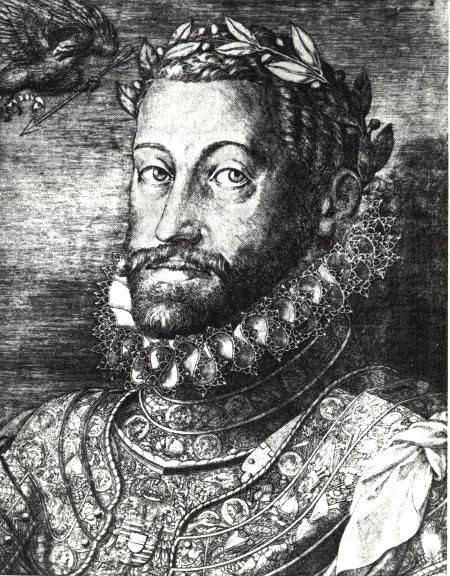
Emperor Rudolf II
born on 18.07.1552 in Vienna
died on 20.01.1612 in Prague
25.09.1572 coronation as King of Hungary (in Pressburg)
22.09.1575 coronation as King of Bohemia and Silesia (in Prague)
27.10.1575 coronation as King of Rome and Germany (in Regensburg)
12.10.1576 Emperor of Rome and the German Reich
The unfortunate rule of Emperor Rudolf II had many negative effects for our Opole. Not only the town, whose defensive walls were crumbling while petitions to the emperor on the matter went unanswered. The borders to the east were also not well secured, and the nobleman Wacław Stadnitzki invaded from Poland (1598), murdered and devastated our lands far and wide (Byczyna, Kluczbork). And not he alone: from Kraków the same was done by the manager of the estates of the Bishop of Kraków, Wożnik. But officially there was peace between the Habsburg emperor and the King of Poland. Information for those interested: the provincial starost (in Silesia) at that time was Count Jan Proskowski, who took the place of Count Jan von Oppersdorff, who died on 3 July 1584 (buried in the Church of the Holy Cross in Opole).
The year 1611. On 25 May in Prague Emperor Rudolf II hands the crown of Bohemia and Silesia to his hated brother Matthias. So we have a new king, because the old king, who was also our emperor, has abdicated.
On 18 September 1611 in Wrocław King Matthias very solemnly receives the bows and homage of all the Silesian Estates.
As Idzikowski writes in “Geschichte der Stadt Oppeln”: ... “Wrocław prepared a magnificent procession. At its head was the provincial starost Count Jan Krzysztof Proskowski. Then the nobility and those accompanying him with 2158 horses, then the representatives of the duchies of Racibórz and Opole. At the head were three representatives of the nobility and behind them a trumpeter with a gold and blue pennant. After this came five riding horses with beautiful harness, decorated with yellow and blue feathers, and on them two ranks dressed in white satin and white leather jerkins. Behind them walked the two barons Jerzy von Rähder of Korfantów and Strzelce and Jan Kochtitzki of Lubliniec, behind them two lackeys and two trumpeters, then 7 ranks dressed in blue and yellow velvet and satin, and after them 27 ranks of servants on horseback in blue and yellow or red and white livery, 3, 4 and 5 to a rank.”
The Silesian Estates prepared a lavish reception for our new king, hoping that the new king would be a better ruler. Great disappointment soon followed.
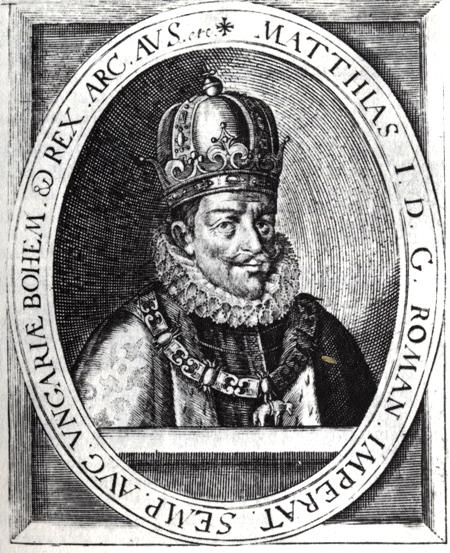
Matthias
Born on 24 February 1557 in Vienna
Died on 20 March 1619 in Vienna
He married on 4 December 1611 in Vienna Anna, Archduchess of Austria and Tyrol
born on 4.10.1585 in Innsbruck
died on 15 December 1618 in Vienna
25.06.1608 In the agreement with his brother Rudolf II the emperor had to cede Austria, Hungary and Bohemia with Silesia to him.
19.11.1608 crowned King of Hungary (in Pressburg)
23.05.1611 crowned King of Bohemia and Silesia (in Prague)
13.06.1612 elected Emperor of Rome and Germany in Frankfurt am Main.
He married only when he held full power, for which he had fought all his adult life with his brother, 5 years his senior. He was the third son of Emperor Maximilian II and had many siblings (16 in all). He grew up and was educated at the Viennese court. Unlike his elder brother Rudolf, he did not stand out in anything. He himself relied all his life on the advice of Melchior Khlesl. The adviser, who offered Matthias all his ideas on government, in reality became the most important person in the state and at the Habsburg court. By suitable efforts he also brought about the election of King Matthias as emperor.
And bad times were coming.
He had no heir to whom he could pass his sceptre. Two factions were forming in the Empire, Catholic and Protestant. The Estates demanded more power. In Bohemia in 1616 conflicts arose over the building of new Protestant churches. Emperor Matthias was obliged by the Catholic Estates in Bohemia to forbid the Protestants from building a new church. He forbade it! Stormy protests followed; the Protestants cited the letters of guarantee of Emperor Rudolf II (of 9 July 1609).
On 29 June 1617 Emperor Matthias proposed that the Estates of Bohemia and Silesia choose Archduke Ferdinand III (son of Archduke Charles II) as their king, as Ferdinand II.
The Estates chose Ferdinand II as King of Bohemia and Silesia only when he had recognised and confirmed the letters of guarantee issued by Emperor Rudolf II. In 1618, after long negotiations, the Estates of Hungary also chose Ferdinand II as their king.
After this coronation Ferdinand II, King of Hungary, Bohemia and Silesia, and Emperor Matthias moved their residences (until then in Prague) to Vienna. In Bohemia the office of provincial starost was installed, similar to the one that had already existed for some time in Silesia, in Opole.
The office of Starost in Oppeln in the years 1501-1630 was held by (data from “Geschichte der Stadt Oppeln”, Idzikowski):
Johan Posadowski (1501, 1532, 1542, 1549) - Johan von Schellendorf (1552) - Johan von Oppersdorff (1557-1569) - Johan Proskowski (1570 and 1589) - Georg von Oppersdorff (1590-1607) - Johan Christoph Proskowski (1607-1619) - Andreas Kochtitzki (1619 and 1620) - Johan Christof Proskowski (1621 and 1622) - Friedrich, Count von Oppersdorff (1626 and 1627) - Ferdynand Melchior, Count Gaschin (1630)
And what was happening in Opole in those same years?
29 September 1501: the town burned down completely through an accidental fire.
27 September 1514: the town burned down completely through an accidental fire.
June 1595: a fire broke out at Dean Stephetius's and the neighbouring houses burned down.
28 August 1615: a fire devastated the town of Opole. The nobles' sejmik was in session in Opole; it was a Friday in a hot summer. Within an hour the town turned into a huge sea of fire. The chronicler Idzikowski writes of 104 townspeople burned to death. Those left alive camped in gardens and fields and went to nearby villages, as they had lost everything.
August 1622: again almost the whole town burned down.
The year 1617: we have a new king, Ferdinand II, and in a year's time the great war of religion will begin, lasting 30 years.
But that will come only in the next, tenth part of Pofyrtane dzieje in our Folwark.
Greetings from Folwark, Rudolf