

In 1562, during the lifetime of Emperor Ferdinand I, his eldest son Maximilian II became our king (14 May). He spent his childhood in Innsbruck, where he learned German in the Tyrolean dialect, a dialect he used for almost all his adult life. He was the favourite nephew of Emperor Charles V, who (when he was 17) appointed him head of state of Spain, and he also took part in military campaigns at Emperor Charles's side.
He had many friends among the young Protestant princes. In their circle he came to know the new interpretation of the Bible, and Pope Paul IV therefore intervened with his father Ferdinand I. The Pope's claims were justified, since this concerned the successor to the emperor of the “Holy Roman Empire of the German Nation”. At his coronation as king, Maximilian II had to swear that he would remain faithful to the Catholic Church.
Small military skirmishes against the Turks brought him no results; in 1568 he made peace at Adrianople, recognising the existing borders between the Habsburg and Ottoman states. Maximilian also sought the Polish crown (1587) after the death of Zygmunt II August (Maximilian's sister Elizabeth was Zygmunt's first wife, they married in Kraków in 1543; after her death in 1545 Zygmunt II married his second sister Catherine, wedding in Kraków in 1553). But his efforts ended at Byczyna with his capture by Zamoyski (Grand Crown Hetman).
In 1589 the Treaty of Będzin and Bytom was concluded, regulating relations between Poland and the Habsburgs; Maximilian II renounced the royal title to the Polish crown and gained his freedom.
In 1564 he was recognised as emperor of the “Holy Roman Empire of the German Nation”.
In 1576, at the assembly in Regensburg, it was decided to organise a campaign against Poland, but the death of Emperor Maximilian II (12.10.1576) thwarted these plans.
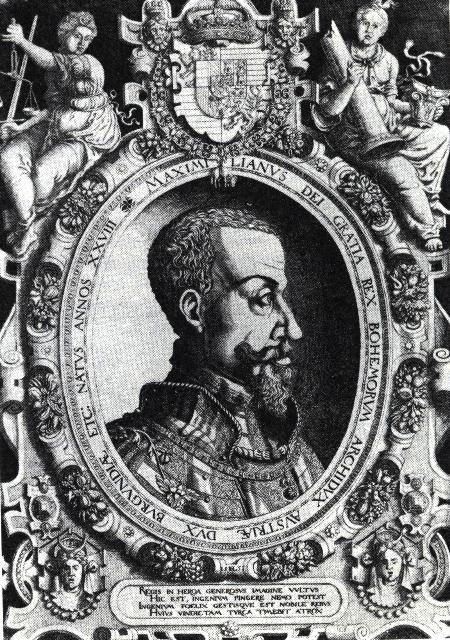
Emperor Maximilian II
born in Vienna on 31 July 1527.
died in Regensburg on 12 October 1576.
Marriage: 13 September 1548
Maria (aged 20), Infanta of Spain,
she bore him 8 princesses and 8 princes (16 in all). Among the princes the eldest, Rudolf V, the later emperor, and the seventh, Matthias, the next emperor after Rudolf V.
14 May 1562 - crowned King of Bohemia in Prague.
24 November 1562 - crowned King of Rome and Germany.
16 July 1563 - crowned King of Hungary
25 July 1564 - Emperor of Rome and the German Reich.
What history writes about him: He was talented, educated and above all tolerant of the Protestants persecuted in his lands. He tried to soften all misunderstandings between the sides. Outwardly he was a Catholic, as he had promised his father; at heart he favoured the Protestants, as the chroniclers write: ... his wife Maria begged him on her knees to return to the faith.
Important for the future of the Habsburg dynasty were the marriages within the family, between close relatives, begun by Maximilian II. They were certainly advantageous for the good of the state, but the offspring of such unions in the following generations were impaired, which was tragic for the survival of the dynasty.
So he gave his beloved daughter Anna in marriage to his cousin Philip II, King of Spain. He gave his brother Charles II's daughter in marriage to King Philip III of Spain; of the thirteen children born of this marriage only two reached adulthood, son Philip and daughter Anna. Anna married her cousin Ferdinand III. The daughter of this union, Princess Maria Anna, married her uncle Philip IV, King of Spain, in 1649, and so on.
The dynasty of the Spanish Habsburgs died out as early as 1700. The Austrian line lasted longer, in the female line almost until the 20th century. But many descendants were regarded as mentally impaired.
Echo of his rule in our Opole: Probably the Turkish war (1566). The issuing of a new “defence order” on 26 January 1576 for the levy of the knights. “Everyone was obliged to do military service in good armour, as may be required of a well-equipped German knight” Idzikowski “Geschichte der Stadt Oppeln”.
Rudolf II, emperor. Eldest son of Maximilian II. Born in Vienna. At 14 he was sent with his younger brother, Prince Ernst, to the Spanish court to remove them both from the influence of Protestant teachings. Under the influence of their uncle Philip II, King of Spain, they were subjected to the thorough and strict influence of the Catholic Church. After 6 years they returned to Vienna. In this time Rudolf II received a very good education. He spoke 5 languages fluently and studied history, astronomy and astrology. The famous astronomer Kepler dedicated his table of planets to Rudolf (Tabulae Rudolphinae).
During the lifetime of his father Maximilian II, the well-educated Rudolf II was crowned King of Hungary (1572), when he was 20, and in 1575 King of Bohemia (and Silesia). His first move was to transfer his seat of office from Vienna to Prague. From that moment Prague became the most important centre of European politics.
This transfer had its reason, because there was unrest on the border with the Turks, and Prague was further away from them. Fear and general dread of the Turks reigned everywhere, in Opole too (as Idzikowski mentions). On 13 May 1577 King Rudolf II had homage paid to him through a commissioner in Opole, and the town was to be thoroughly rebuilt (this concerned strengthening the walls and towers). In Opole there was fear not only of the Turks but, even more, of the Poles, of Hetman Zamoyski, who at Byczyna defeated and captured Maximilian II (the claimant to the Polish crown), and of the terrible devastation he caused in Byczyna, Kluczbork and the surrounding villages (according to Idzikowski, “Geschichte der Stadt Oppeln”).
Opole suffered great price rises; a bushel of rye cost 3 thalers. On 15 October 1582 the Gregorian calendar was introduced, Pope Gregory XIII (average length of the year 365 days). In Opole the new calendar applied from 1584. On 3 July 1584 Johann, Count Oppersdorff, died.
For a few weeks the Duchy of Opole was the property of the Prince of Transylvania, Zygmunt Batory (April to August 1598), which the Emperor exchanged for Transylvania. The change of owner disrupted the work of the Silesian Chamber in Wrocław, which dealt with financial matters. Organisation in the state began to fail. Noblemen from Poland began to raid and devastate the country far and wide. The defensive walls began to crumble. In 1581 the town hall was in danger of collapse.