

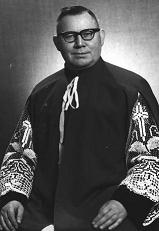
He was born on 8 March 1906 in Sowczyce near Olesno. In 1925 he graduated from the grammar school in Kluczbork. From 1925 to 1930 he studied philosophy and theology at the University of Wrocław (Breslau). He was ordained a priest in Wrocław by Cardinal Bertram on 2 February 1930. He was connected with the parish of Chrząszczyce for 41 years. From 1930 to 1935 he was a curate in Gliwice and a pastor in Wolgast. For the following four years, 1935 to 1939, he was in Wrocław (Breslau): in 1935–37 as repetitor at the Higher Seminary, where he taught Polish, and in 1937–1939 as prefect of the Wrocław seminary in the Collegium Georgianum. On 21 September 1939 he became parish priest of the parish of Schönkirch – Chrząszczyce.
The life of the Prelate in our parish, from 21 September 1939 to 20 January 1980
His priestly service as parish priest began at a truly difficult moment. On 15 July 1937 the Geneva Convention on minorities in the area of Silesia covered by the plebiscite expired. Both states, Germany and Poland, to which the respective territories had been assigned after the partition, were obliged to respect minority rights. In Opole Silesia the Polish minority received rights, in Katowice Silesia the German minority. This was above all the right to hold services for the minorities in churches. The press – “Powstaniec Śląski” no. 1 of 1932 in Polish Silesia – and the NSDAP in German Silesia attacked the church authorities, demanding that they forbid services in the minority languages. Cardinal Bertram did not yield to the party, whereas the Polish press successfully incited the Polish Silesians, who disturbed or even made impossible the holding of services for the German minority.* “Signs of preserving what was Czech or German in Zaolzie were regarded as treason against Polishness”**.
On 29 June 1939 Bishop Adamski announced publicly: “I temporarily suspend in all churches of the diocese and of the church administration in Silesia and beyond the Olza the use of the German language, also in churches where there have been no excesses so far.” For the German government and the NSDAP, Bishop Adamski’s move in Polish Silesia was convenient. The abolition of services in Polish in Opole Silesia was ordered, which Cardinal Bertram had to carry out. Cardinal Bertram announced the suspension of services in Polish in the diocese of Wrocław. “The last Mass in this language on St Anne’s Mountain and in a few other churches took place on 29 July 1939. Some historians write only of the suspension of Polish services in German Silesia, forgetting that they were suspended first in Polish Silesia.”***
A month later, on 1 September 1939, the Second World War broke out. As already mentioned, on the 21st day of the war, which was only gathering pace, the 33-year-old Fr Jan Skorupa became our parish priest. He had no time to get to know many parishioners, especially the younger ones, because they were called up for military service. The first news from the front also arrived, about those fallen for the fatherland, for the Führer, and the next ones were taking leave of their families, because the Führer needed them. In the last days of January 1945 new times began for the church, now in Poland. For those interested in this subject I refer to the literature (Ewald Stefan Pollok, “Śląskie tragedie”); our parish priest became a member of the Diocesan Council that year and confessor of the Hospital Franciscan Sisters, and in 1947 he was appointed a member of the Board of Trustees of the Diocesan Printing House. On 5 February 1951 he was arrested by the Security Office (known to all older people as the UB) and released after 3 weeks. From 1952 he was an examiner and pro-synodal judge, and secretary of the Pension Fund.
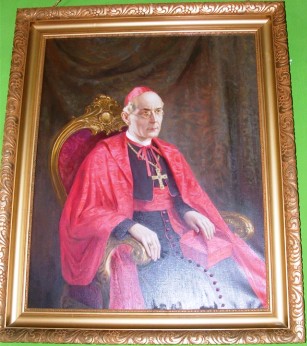
A photograph of the portrait of Cardinal Bertram, taken on 11.09.2006 in his former residence in Javorník (Czech Republic). He performed the solemn consecration of our church on 7 October 1923. From his hands the following received priestly ordination: Fr Jan Skorupa on 2 February 1930, Fr Alfons Rolnik on 31 January 1932 and Fr Karol Bromer on 5 April 1936. For his short biography see below.
The year 1945 – NEW TIMES. Aleksander Zawadzki said on 22 March 1945 at a meeting of district heads in Katowice that he would not allow Masses in German to be celebrated anywhere in Silesia. Priests who did not comply with this order would be admonished, and if they continued to hold services in that language they would be isolated and sent to camps.* (minutes of the district heads’ meeting) The priests of the Wrocław diocese wrote a letter to the Conference of Bishops (June 1945) in Częstochowa asking them to intercede with the authorities so that this language could be used at confession and in preparation for First Communion. To this the Bishop of Katowice, Stanisław Adamski, wrote on 11.07.1945: “The introduction of the Polish language throughout the diocese is meant to show German society that these are exclusively Polish lands and that the Germans should leave them.” (M. Kneip, “Die Deutsche Sprache in Oberschlesien”, Dortmund 1999)
On 8 September 1945 Cardinal Hlond appointed Prelate Bolesław Kominek head of the “new apostolic administration of the Opole district”, contrary to the recommendations of the Holy Father. Pius XII said: “We did not want this”, and the German side held that Hlond had “lied to Pope Pius XII and extorted from him powers which he then far exceeded and abused”. On 24 October 1946 Cardinal Hlond, Primate of Poland, wrote to the Secretariat of State in the Vatican: “Practice has, unfortunately, confirmed that this idea contained a human error. My error.” The administration of Prelate B. Kominek comprised 39 deaneries and 438 parishes. Our parish belonged to it as well. After taking over the administration, Prelate B. Kominek visited the deaneries subordinate to him one after another. In Gliwice Prelate B. Kominek said to the assembled priests: “I am glad that at last the whole of Silesia has returned to the Motherland. A new epoch has begun in the history of Poland. In the future there will be no place for the German language and culture. We do not want to have anything to do with the Germans. From this moment on, only Polish may be spoken in church.” Source: Thomas Urban, “Niemcy w Polsce” (Germans in Poland), Silesian Institute in Opole.
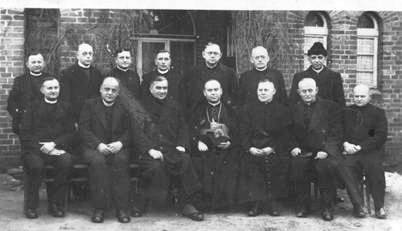
The Administrator, Prelate Bolesław Kominek (in the middle), at a meeting of our Deanery in Chrząszczyce in the winter of 1945–46.
On 26 January 1951 the Apostolic Administrator Bolesław Kominek was taken away to Kraków – in the morning, shortly before the Opole curia opened, UB officers burst in and informed him that he was being removed and expelled immediately. He was abducted to Kraków in a militia car and then placed in a village in Lesser Poland. The removal of the apostolic administrators was meant to end the state of provisional church administration in the “Recovered Territories”. In place of Bolesław Kominek, Fr Emil Kobierzycki was chosen under pressure from the UB. The Primate feared the authorities and accepted the choice. At the beginning of his activity in the Opole region, Prelate B. Kominek had forbidden the use of the German language throughout Upper Silesia during services, and also at confession. By such treatment of the German Silesians he alienated them. Cardinal A. Bertram was held up as a model: before the war, in the hard times of fascist rule, up to 1939 he sent pastoral letters in German and Polish to every parish. At the beginning of 1950 the Polish Episcopate – under pressure from the communists – began to remove the apostolic administrators from the “recovered territories” and appointed in their place capitular vicars, wholly subordinate and compliant towards the party and the government. The Primate of the Millennium, Cardinal Stefan Wyszyński, confirmed them for fear of a possible schism. Fr Emil Kobierzycki played a very inglorious role in 1954. He is responsible for the expulsion from the Opole region of about 20 priests – Silesians. He then issued a decree on the removal from parishes of Silesian priests who in their religious activity before and after the war cared equally for people of both Polish and German origin. In 1954 in Silesia 323 women’s convents belonging to 10 congregations were also liquidated and 1500 sisters were taken from them to labour camps in the Kraków, Bydgoszcz and Poznań voivodeships. The priests must go. In July 1954 the authorities demanded the removal of 21 parish priests and their transfer to central Poland for the purpose of “repolonisation”. They were accused of being Germans and of Germanising the local population. Under pressure from the authorities the Opole curia then gave way. The priests were handed decrees removing them from their parishes, which invoked the relevant canons of church law, including the alleged hatred of the people towards the parish priests.
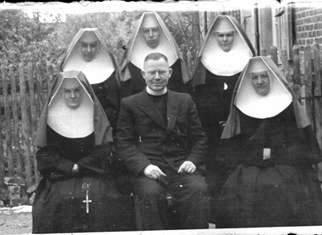
Top, from the left: the sister née Gambiec from Górki ran the kindergarten; Sister Waleria looked after the church; Sister Angelika – organist. Bottom, from the left: the Mother Superior, Fr Jan Skorupa, the nursing sister. The photograph was taken on 09.07.1954, the day before his departure – his internment.
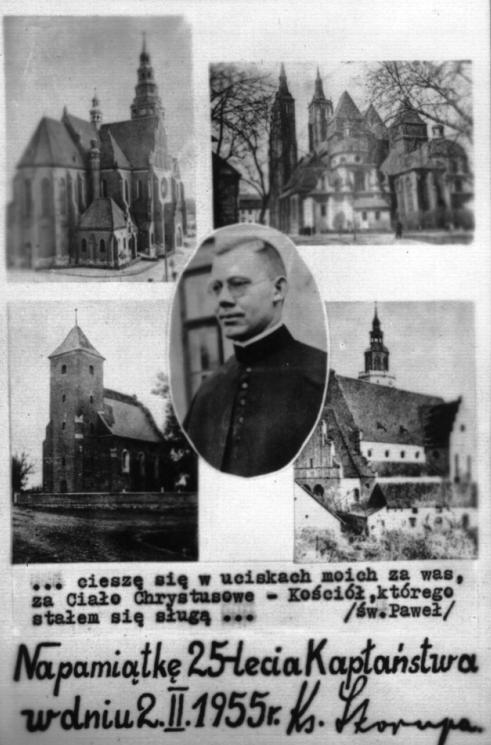
A souvenir of the 25th anniversary of ordination, 2.II.1955.
On 10.07.1954 Fr Jan Skorupa was interned by the UB (he stayed in Jarocin in Greater Poland and in Benice near Krotoszyn). He had to celebrate the 25th anniversary of his priesthood in exile.
On 17.12.1956 he was released after 2.5 years of internment. The expelled priests resented not only the state authorities but also the church authorities, who had not said firmly: “We do not allow it!” Those words, on the part of the Church, would however have required heroism. That was lacking. After release from internment Bishop Franciszek Jop restored the priests to their former parishes, but seven decided to leave for Germany. Here I will state once more that before the war Fr Jan Skorupa had taught Polish for 4 years, from 1935 to 1939, at the German seminary in BRESLAU.
After 32 years Cardinal B. Kominek writes: “‘Repolonisation’ is not the happiest expression. It was used and abused in the first years after the war. One would most gladly skip this shameful, even painful period of errors and distortions.” Based on: Cardinal B. Kominek, “W służbie Ziem Zachodnich”, Wrocław 1977.
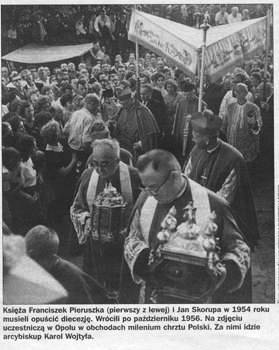
In the photograph (copy from the Opole press): from the left Fr Franciszek Pieruszka and Fr Jan Skorupa. Behind them walks Archbishop Karol Wojtyła – later Pope John Paul II.
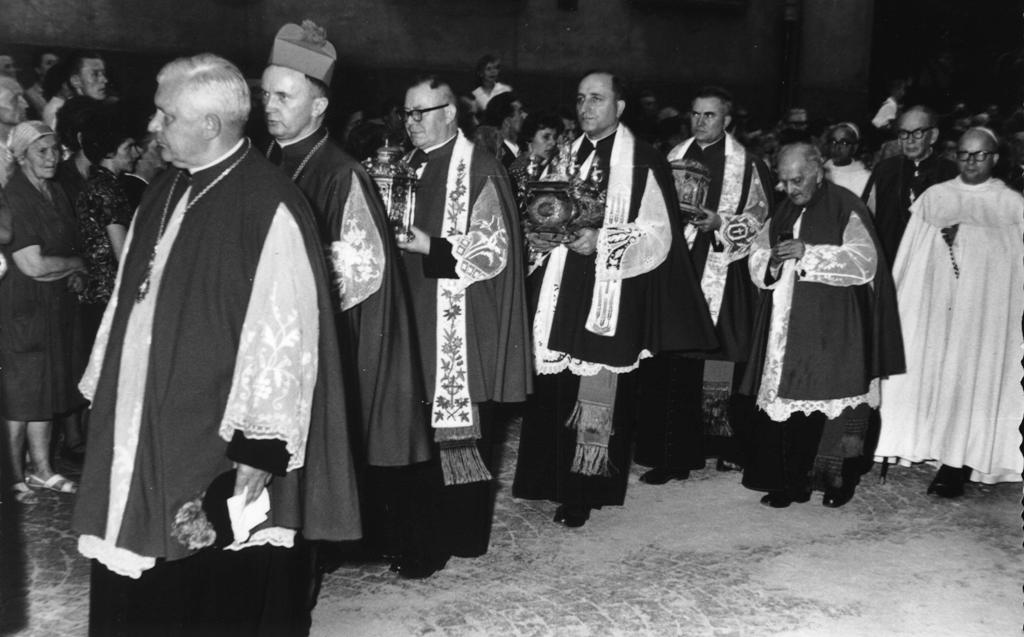
The year 1966 – Millennium – 1000 years of Christianity – the cathedral in Opole.
He did not break down during his 2.5 years of internment. He was released in December 1956, and already the following year, 1957, he made efforts – with the support of the residents of Domecko – to build a new church in that village. He must have been very strong! He won the consent of the church authorities and above all of the communist authorities for the building of the church. True, after Stalin’s death there was a certain thaw in relations with the Church, but the new regime had already consolidated, and with each day it was harder. On top of that came permanent shortages of building materials. But the “foundation stone” was blessed in October 1957 and building began. What a “pace”: already in August 1960 Fr Jan Skorupa blessed the church. Yes, he knew that only such haste could save the begun building from the designs of the authorities, who had other plans and wanted to assign the building to cultural purposes. The solemn consecration was performed by Bishop Franciszek Jop in September 1961. For the running of the new church, which was now a branch of the parish church in Chrząszczyce, the parish priest Jan Skorupa appointed his curate, Fr Wilhelm Skorupa (a coincidence of surnames – not related). After the death of Prelate Jan in 1980, Bishop Alfons Nossol by decree established the church in Domecko as an independent parish for the villages of Domecko, Nowa Kuźnia and Pucnik, and appointed the previous curate of the parish of Chrząszczyce, Fr Wilhelm Skorupa, as parish priest.
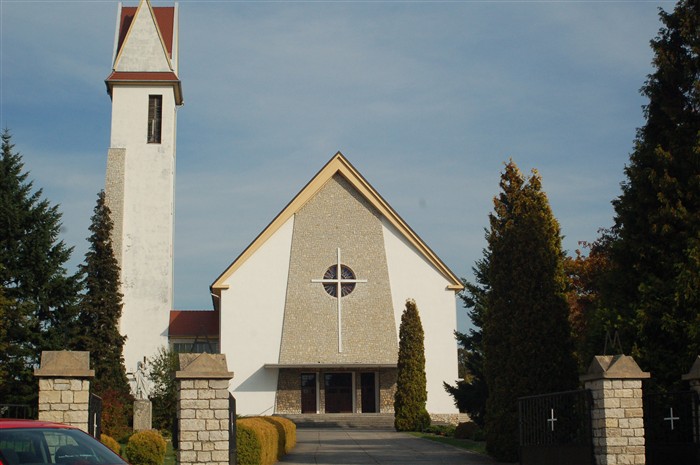
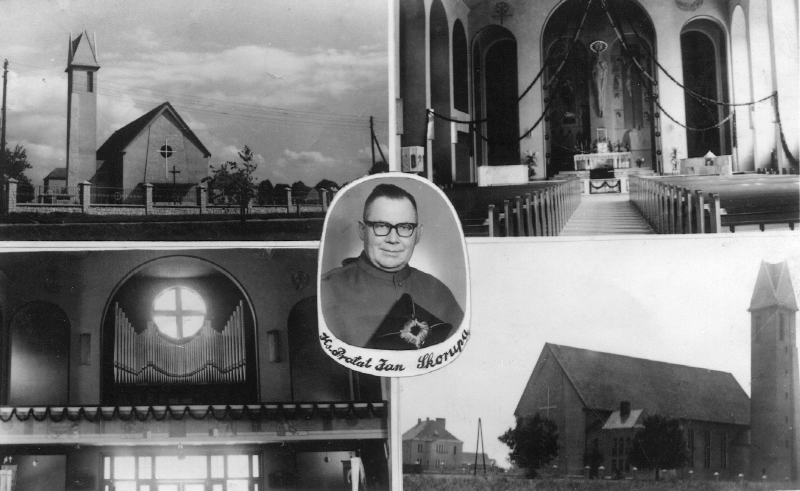
A view of the church in the new parish of Domecko; below, a postcard on this subject.
The further path of Fr Jan Skorupa. In 1957 Bishop Franciszek Jop appointed him Diocesan Consultor, that is, the bishop’s closest collaborator. On 15 February 1960 Fr Jan Skorupa was elected Dean of the Proszków Deanery. On 24 November 1962 he was appointed Prelate – Papal Chamberlain of Pope John XXIII. In 1978 he was again elected Dean of the Proszków Deanery. On 19 November 1975, by decree of the Holy See, he received a “Thank-you for cooperation around the Work of the Catholic Missions”.
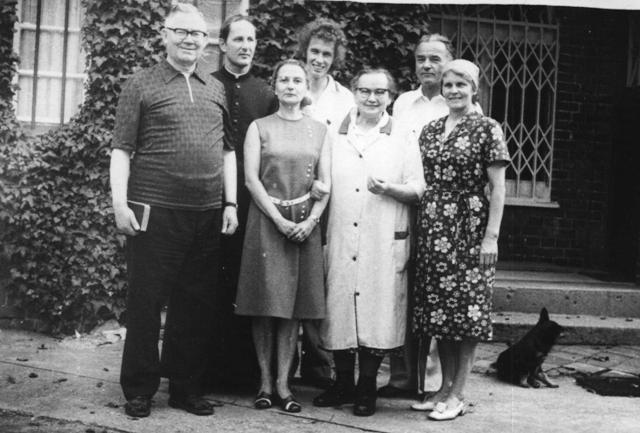
At the parsonage in Chrząszczyce (from the left: Fr Jan Skorupa, curate Fr Wilhelm Kudelko, Maria Wiendlocha, a guest from the Federal Republic of Germany, Sister Klara Liefländer, Walter Segiet, Jadwiga Gryc).
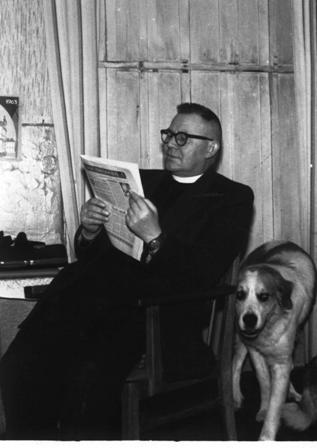
The year 1963 at the parsonage in Chrząszczyce.
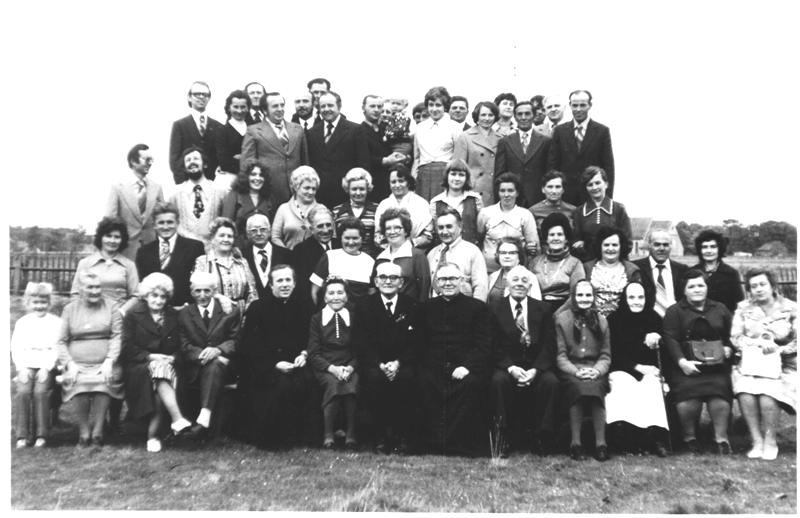
Golden wedding in Sowczyce: Teofil Skorupa and Marta, née Wiendlocha. In the third row from the left, the sixth, Elżbieta Sobala, who owns the photograph. Teofil is the brother of Fr Jan. In the photograph, the closest family.
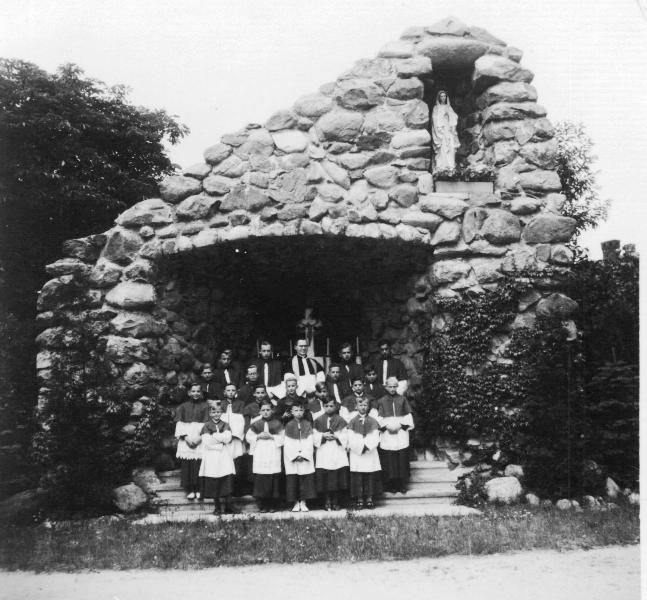
The masonry grotto built of stones collected by the residents of the parish of Chrząszczyce, built on his initiative on the church square on the west side of the church. Photo: among his altar servers. Year?
He died on 20 January 1980. The funeral of Prelate Jan Skorupa in Chrząszczyce was led by our bishop, Prof. Alfons Nossol (now archbishop).
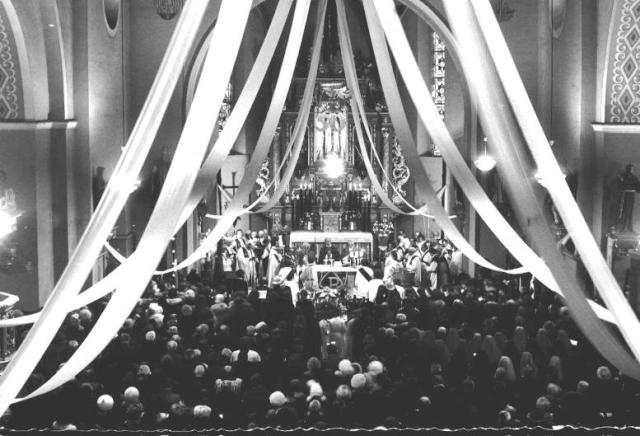
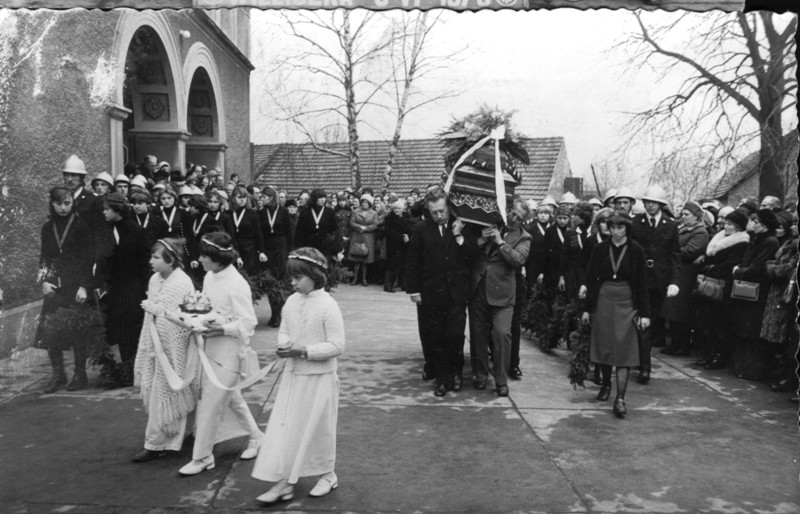
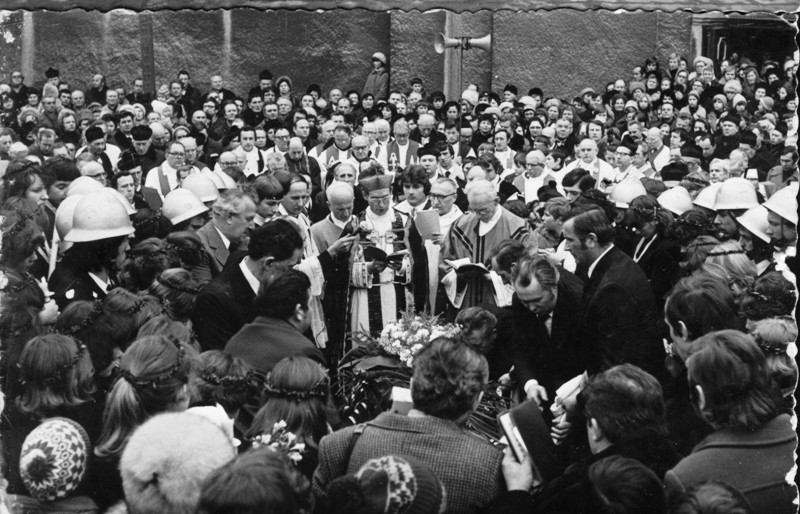
Funeral ceremonies for Prelate Jan Skorupa in our church.
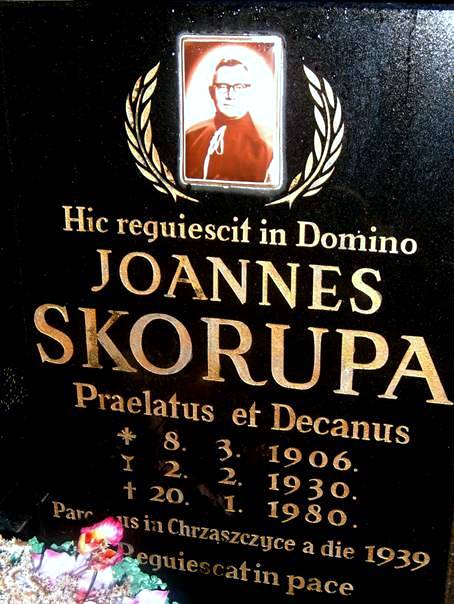
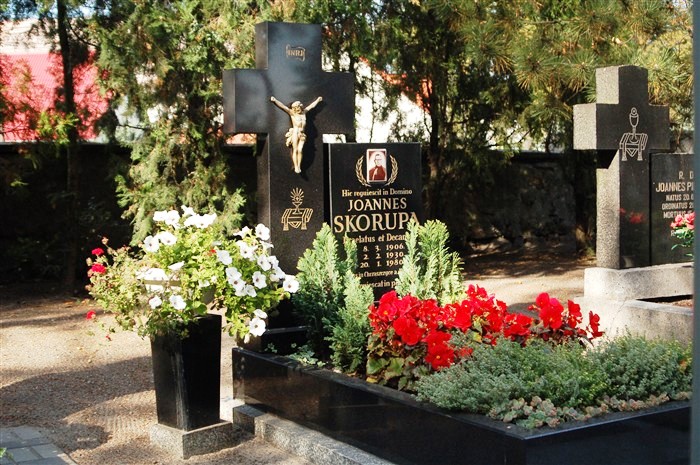
His grave, next to the church on the north side.
Cardinal Adolf Bertram – short biography
Adolf Bertram was born on 14 March 1859 in Hildesheim. He was ordained a priest on 31 July 1881. He was appointed Bishop of Hildesheim on 26 April 1906 and consecrated bishop on 12 June of the same year. He became Prince-Bishop of Wrocław on 27 May 1914 and cardinal on 4 December 1916. The archdiocese of Wrocław, the largest in Germany at that time, covered almost the whole of Lower and Upper Silesia, the bishopric of Berlin, the bishopric of Warmia and the prelature of Piła. After his death on 6 July 1945 Cardinal Bertram was buried in the cemetery at Javorník on 11 July 1945 (Czech Republic). In November 1991 the cardinal was reburied in Wrocław Cathedral. Fr Jan Skorupa was ordained a priest by Cardinal Bertram on 2 February 1930, and Fr Alfons Rolnik on 31 January 1932 (in Breslau) in Wrocław. Cardinal Bertram also performed the solemn consecration of our church on 7 October 1923.
Sources
Compiled on the basis of: * J. Macała, “Duszpasterstwo”, p. 136; ** Fr H. Olszar, “Podział narodowościowy kapłanów diecezji katowickiej i Administracji Śląska Zaolziańskiego w okresie międzywojennym”, Kwartalnik Opolski 1/1996, p. 55; *** Ewald Stefan Pollok, “Śląskie tragedie”, p. 298; “Każdy ksiądz miał swoją teczkę”, NTO reports; “Represje wobec Kościoła Katolickiego (1945–1989)”, IPN Wrocław.
Photos: private archive of Elżbieta Sobala, Mikołów – family photographs, all concerning Fr Jan, lent for copying and publication on the Internet by Mrs Elżbieta Sobala of Mikołów on 01.10.2007. Dear Ela, heartfelt thanks! Otylia Kania – Folwark, Piotr W. Rudolf Zmarzły – Folwark.
The original free German translation was made by Bernadeta and Adrian Zmarzły, Köln; the German version on this site has been revised.