

The sons of Władysław II “Wygnaniec” begin their rule in Silesia in 1163.
| Bolesław “Wysoki” (*c. 1127-1201) Duke of Silesia 1163-1177, Duke of Wrocław 1177-1201, Duke of Głogów 1180/90-1201 | Mieszko “Plątonogi” (*-1211) Duke of Silesia 1163-1177, Duke of Racibórz 1177-1211, Duke of Opole 1202-1211, Duke of Kraków 1210-1211 | Konrad, Duke of Głogów 1177-1180/90 |
|---|
If you look closely at the dates above, you can clearly see how quickly the owners changed in Silesia, and these were only brothers.
In 1163 Bolesław “Kędzierzawy” agreed (under pressure from the emperor) to the return of the sons of “Wygnaniec”.
In 1172, after 9 years, Bolesław “Wysoki” had to leave Silesia and seek help from Emperor Frederick “Barbarossa” (the causes of the conflict are unclear). War did not break out, but “Kędzierzawy” paid a one-off tribute of 8 thousand marks.
In 1177 the brothers again became involved in armed conflict with each other. After the return from exile (1163), Konrad, who was destined for the clergy, had been passed over in the division of Silesia. The Silesian lands were divided again. Bolesław “Wysoki” kept Wrocław (with Opole), Mieszko “Plątonogi” received the Racibórz lands, and Konrad was left with the Głogów lands, which after three years (after his death) Bolesław “Wysoki” again joined to his own.
In 1195, that is 6 years before his death, he handed the Opole lands to his son (Jarosław), who from 1198-1201 was at the same time elected Bishop of Wrocław (the election being forced by his father). This Jarosław commanded a corps in 1195 at the battle on the Mozgawa near Jędrzejów against the troops of Leszek Biały. Jarosław then received Opole and the Otmuchów land including Nysa. He died in 1201.
In 1201 Bolesław “Wysoki” dies.
In 1201, after the death of Bolesław “Wysoki”, his second son Henry (called the Bearded) takes over the Duchy of Wrocław. A “new era” begins in Silesia, the “Monarchy of the Silesian Henrys” (1201-1241).
In 1201 Henry takes his brother's lands (Jarosław; it is not known whether before or after his death in 1201. It is known only that Jarosław died a few months before his father), the Duchy of Opole, and joins them to his patrimony, the Duchy of Wrocław.
In 1202 Mieszko Plątonogi takes the Duchy of Opole by force (from his nephew Henry) and joins it to his own, Racibórz.
Today we regard Mieszko “Plątonogi” joining the Duchy of Opole to Racibórz at the start of the 13th century as the official creation of the Upper Silesian duchy, known from then on as the Duchy of Opole. But the formation of the new Opole-Racibórz duchy by no means meant the end of wars between the Piasts, in Silesia and beyond.
At that time Opole developed relatively quickly into a significant Polish town from the Polish village it had been since Silesia was conquered by the warriors of Mieszko I (around 990, although I have also found a statement that the village of Opole was taken by Bolesław Chrobry in 999). The surrounding area of course became the Opolszczyzna. But the wars that kept breaking out were destructive and the town itself no doubt burned many times. Defensive walls (palisades) were no doubt built to protect the inhabitants from their neighbours (brothers, nephews, uncles, the list would be long: invaders). There is much information on the building of the fortifications, but authors attribute it to various rulers of Opole, so I have not analysed this subject. Since Bolesław “Wysoki” had already begun settling it under German law, a market square was needed. The area between the village (today the neighbourhood of the church on the hill) and the River Oder was chosen. And it is very likely that the area and the (parallel/perpendicular) streets were planned as the town plan of 1750 shows (see part II of “Pofyrtane dzieje”). This suggestion was put forward by F. Idzikowski in “Geschichte der Stadt Oppeln”.
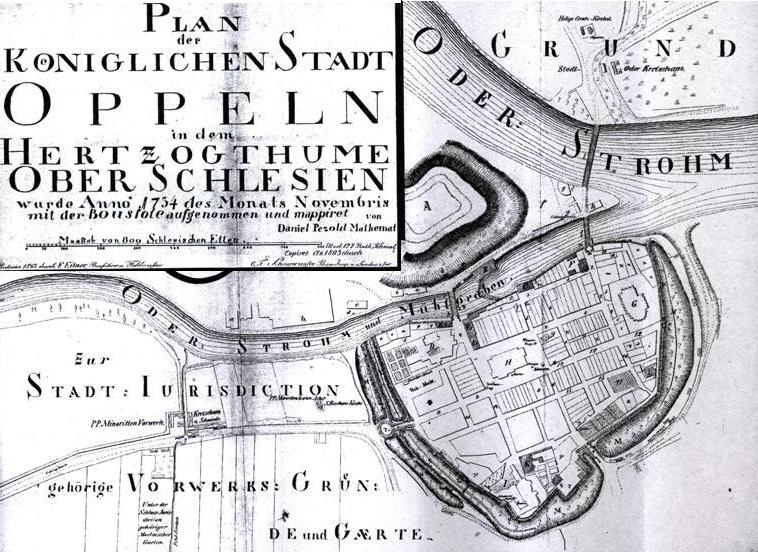
Opole - plan of the town in 1734. Made by the mathematician Daniel Pezold.
The royal town of Opole in the Upper Silesian Duchy.
How the settlement of Opole under German law looked in practice at that time I have not read anywhere. There are only records of colonists. First of all (1175), Bolesław “Wysoki” brought Cistercian monks from Saxon Pforte to Lubiąż. Pforte is a place near Altenburg where the brothers spent several years in exile. The Cistercians knew about building in brick. The monastery also became a centre of writing. Today we use those records (Life of St Hedwig of Silesia, the Henryków Chronicle, or the Catalogue of the Bishops of Wrocław). In the 13th century several daughter houses were founded. Plątonogi's wife Ludmiła founded a convent in Rybnik, which her son Kazimierz, Duke of Opole (1211-1230), moved to Czarnowąsy. The monks brought to Silesia received from the duke large grants of land and privileges allowing them to settle German colonists on the monastery's estates. German knights and clergy lived at the courts. German cultural models were drawn on, and marriages arranged with German families.
The colonists settled under German law enjoyed in the first years the so-called “wolnizna”, exemption from all services for the time of development. The inhabitants of Opole first of all gained personal freedom, without wolnizna.
German law (apart from the wolnizna period) guaranteed personal freedom.
The right to dispose freely of the farm, on condition of fulfilling the set obligations.
The right to self-government (own courts of first instance: wójt for the town, sołtys for the village).
Exemption from all additional unrecorded services owed to the duke by the inhabitants of a place founded under ducal, Polish law.
An important element of settlement under German law was the possibility of paying one's dues to the duke in money. A money and goods economy developed rapidly. German settlers also contributed to the development of agriculture in Silesia. The first towns in Silesia founded under German law were Złotoryja, Lwówek and Środa Śląska. Opole, as can be read in various records, drew in later years on the experience of the law of Środa. That is, Magdeburg law, called German law, was modified in the following years according to local conditions. The self-government laid it down, and the duke, later the emperor or king, confirmed it.
The wójt, the locator (sołtys), represented the owner (duke, king or emperor) and had a considerable range of power. He was the first instance of justice! Self-government, the town council, was introduced only in later years, and even so it sought to take over the powers of the wójt or sołtys.
In the times we are now in, the beginnings of German colonisation, nobody even dreamed of a change in the lot of the Folwarczanie. Ducal law applied, which made the inhabitants of Folwark unfree. They were forced to do any work for the current owner of Opole and the Opolszczyzna, that is Mieszko “Plątonogi” in 1202-1211, then his son Kazimierz 1211-1230, then his grandsons (Mieszko II “Otyły” 1230-1246 and Władysław I 1246-1281). And all of them in turn were mixed up in various wars and little wars. And their warriors plundered, raped and murdered, and burned villages and towns along the way.
The great-grandson Bolko I (of Opole) 1281-1313 deserves more space, because he was the first to “announce” and record that there was such a village as Vorwerk des Desco, that is, a ducal one.
Mieszko “Plątonogi” is regarded as the progenitor of the Upper Silesian Piasts
“Plątonogi” was at that time (1210) the oldest living Piast and wanted, on the basis of the “Testament” of Bolesław Krzywousty of 1138, to take the Polish throne in Kraków. Pope Innocent III issued a mandate (1210) recommending that the statute of “Krzywousty” be observed. In this he had the (not disinterested) support of his nephew, “the Bearded”, who was also thinking of the throne after his uncle. Mieszko “Plątonogi” took Kraków by force and for a year was Duke of Opole, Racibórz and Kraków. His death (1211) put an end to all plans.
To conclude today's reflections on “Pofyrtane dzieje Folwarku”, I can write that only in 1228 did Henry “the Bearded”, in his duchy (Wrocław), for the first time allow a village inhabited by a Silesian population to be settled under German law. It is only 90 km to Wrocław, and we shall wait another 200 years for this moment, although in 100 years we shall already find ourselves in a different state.
From still unfree Folwark, greetings from the great- - - - great........grandson Rudolf