

Someone once said: ... “Every generation must make its own reckoning with history; it must create its own way of viewing the past. History in the social sense will never become a set of truths established once and for all.” While the facts (as a rule) arouse no discussion, their interpretation often arouses disputes and controversy. The history of Silesia is a good example.
We live in Folwark, near Opole, in the valley of the River Oder, in Silesia (Śląsk - Slensk - Schlesien - Silesia), which is marked by a distinctly independent character. We find no written history of Folwark in old documents. The first mention, in the grants made on 17 November 1295 by Duke Bolko I of Opole to the Minorite Order, also names Vorwerk des Gesco (the lord's). It is not certain whether this means today's Folwark. On the other hand, there is no other place of similar name in the Opole area.
Opole owes its historic origin to the favourable lie of the land on the River Oder. From Wrocław onwards its left bank is higher than the right, until over about 2 km in the area of today's town the two banks level out, and then the right bank becomes several metres higher. Also of importance for the first settlers of Opole was Ostrówek island, formed by the division of the main stream of the Oder into two channels, the Oder and the Mill Canal. In our Folwark the role of an island like Ostrówek in Opole was played by the island of “Przewrócie”, visible on old maps. For the first inhabitants of Opole, Ostrówek was a very good, “strategically” safe place, as was our Przewrócie, where you could hide and secure your belongings.
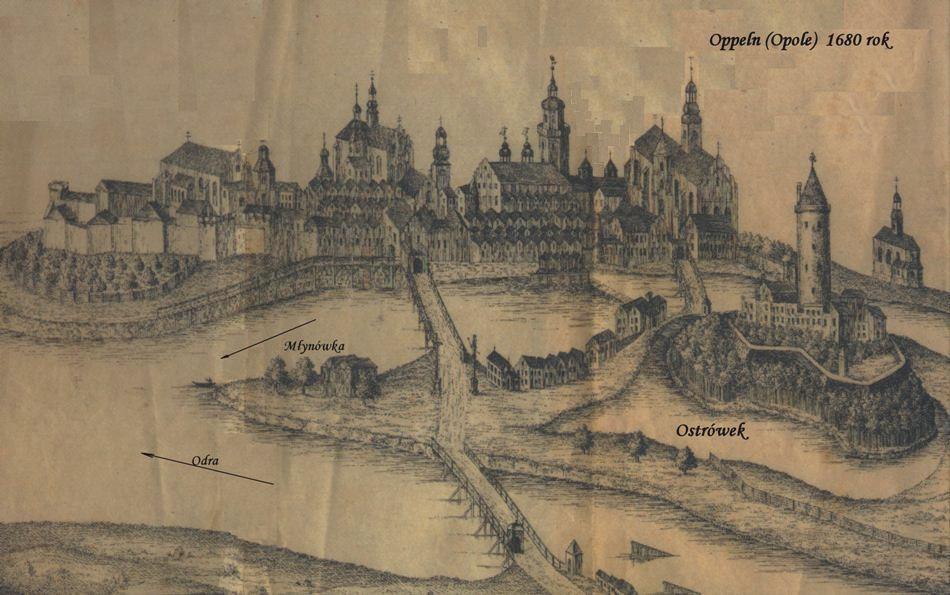
Opole in 1680, the Piast castle on “Ostrówek” island (copy of the cover of “Opole do 1863”, F. Idzikowski.)
Who are we?
300 years before the birth of Christ. From the south, through Bohemia and the Moravian Gate, people from the Danube lands flow into Silesia: the Celts. Traces of their settlements have been found on the Głubczyce Plateau near Nowa Cerekiew. The Celts, a great people, from whom came the Gauls, ancestors of the French, Irish and Welsh.
They represented a more developed civilisation than the locals, but could not create a state. They used the potter's wheel to make clay vessels and two-chamber kilns to fire them. They could smelt iron from bog ore in furnaces. They used improved tools for farming; an iron ploughshare was found at Brzeg, dated to 300 years AD. They probably mixed with the more numerous local population, passing on or imposing much of their culture. They also took control of the working “amber road”, which led across the crossing of the Oder in our Opole.
On the “Amber Road” in Opole, Zdenek Vana (Czech archaeologist and historian, *1924 in Prague) writes: On the same route from Prague to Kraków and on to Rus lay an important trading, craft and farming centre in Opole. This fortified settlement on one of the Oder islands was at first the centre of the Opolanie tribe, and in the 10th century a stronghold was built here, surrounded by a rampart of wood and earth with three gates and log houses along regular streets paved with wood. Extensive trade contacts are shown by finds of Byzantine silk, pearls from the Persian Gulf, fragments of an Arab glass cup, Scandinavian clasps, Ruthenian clay Easter eggs, spindle whorls and bells, Rhineland bronze bowls, Moravian graphite pottery, and so on.
In our Folwark and the immediate area (Winów, Chrzowice), during the building of the road (no. 45) and of many houses, as well as in the fields, traces of settlements from this period have been documented.
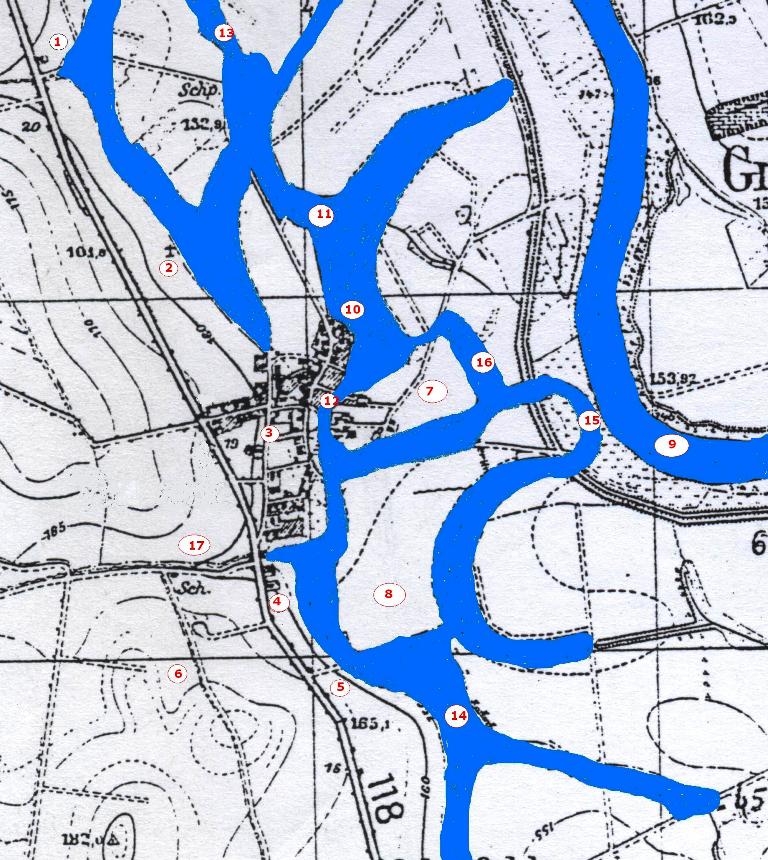
Reconstruction of the floodwaters around Folwark in the 16th century, before the regulation of the River Oder, and documented archaeological sites.
Based on the floodwaters during the flood of 1997. Archaeological sites: based on documentation from the Voivodeship Office in Opole
Key: (archaeological sites nos. 1-6). To make this information easier to read, I am adding a short guide, because I know from my own experience how hard it is (for non-historians) to find their way around this subject.
Period:
8000 BC - 4500 BC Mesolithic
4500 BC - 1800 BC Neolithic (Corded Ware culture)
1800 BC - 700 BC Bronze Age
700 BC - 400 BC Iron Age (Hallstatt culture, from the cemetery at Hallstatt, Upper Austria)
400 BC La Tène culture
1300 BC - 1100 BC Lusatian culture (Lusatia, Silesia, Greater Poland)
100 BC - AD 500 Przeworsk culture (created by Germanic peoples and partly Celts)
400 BC - AD 375 Roman period
1. Archaeological site in Winów. Plot 1149/192 Ryszard Waleska, area 90-37, site 69. Surface surveys carried out by E. Tomczak (1972) west of the pond as far as the road, discovered: a settlement point of the Przeworsk culture, 10 vessel fragments from this period. Settlement point, prehistory, 14 vessel fragments. Settlement from the 14th-15th c., 8 vessel fragments. E. Tomczak reports that not all the sherds were collected.
2. Archaeological site in Folwark. Plot 108 (Smolin). Next to the wayside shrine in the field (1627). Area 90-37, site no. 79. A settlement point of the Przeworsk culture from the late Roman period and 5 vessel fragments were discovered. Settlement traces from the 14th-15th c. and 2 vessel fragments were discovered.
3. Archaeological site in Folwark. Area 90-37, site 80. In 1903, during the building of Drass's house, a settlement point from the period of the “Lusatian culture” was discovered. Vessels and vessel fragments from 1300-1100 BC were found.
4. Archaeological site in Chrzowice. From the period 4500-1700 BC. Area 90-37, site 81. Sand pit on Wiktor Gielnik's field. During sand extraction settlement traces from the period of the “Corded Ware – Neolithic” culture were discovered. In July 1961 a pot was found, 12 cm high, rim diameter 11 cm, base diameter 7 cm. It is listed in the register as “Decorated vessel”. It was handed over to the Muzeum Śląska Opolskiego by Stanisław Kornek.
5-6 Archaeological sites in Chrzowice. Cultural period (Hallstatt, Przeworsk, Lusatian from Roman times). Vessel fragments, settlement points.
7-8 “Przewrócie” island and in the Chrzowice area 8 “Na Granicach” island
9. Course of the River Oder after regulation (1760).
10. Remnant of the floodwaters, “Za Walą” lake
11. Remnant of the floodwaters, “Na Kampie” lake
12. Remnant of the floodwaters, “Wiejskie” lake
13. Remnant of the floodwaters, “Czorne” lake
14. Remnant of the floodwaters, “Kotuc” lake
15. Remnant of the floodwaters, “Za Groblą” lake, no longer in existence (the “Folwark” mine filled it with marl waste)
16. Remnant of the floodwaters, “Hodne” lake, now a fish pond
17. (Dry) watercourse “Wielkou Pyska”
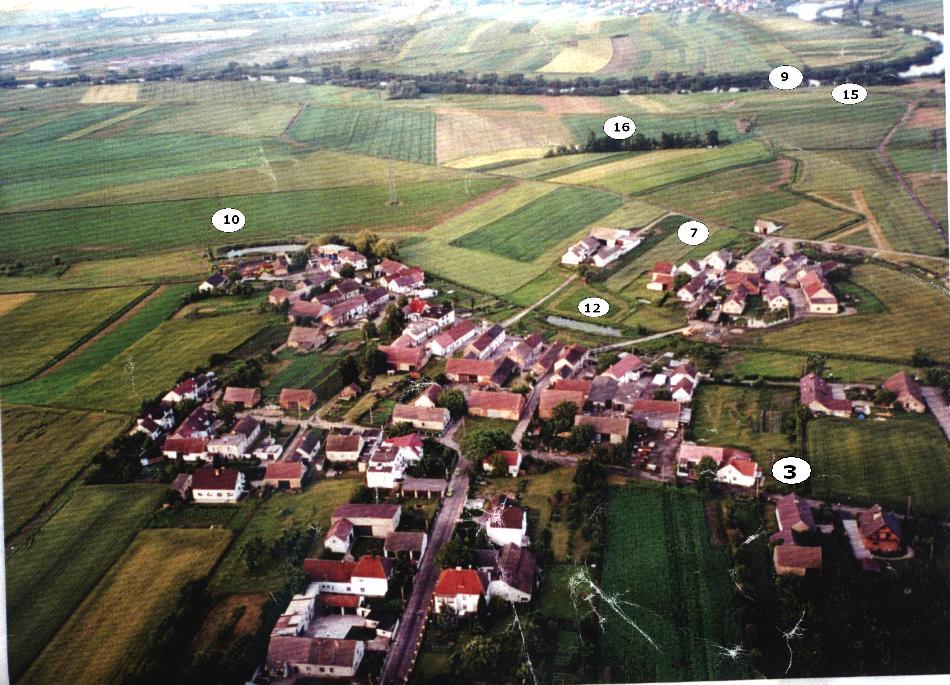
Folwark, aerial view (1995)
In the 2nd and 3rd centuries AD Silesia came into the orbit of the Germanic peoples. From the north came the Silingi, one of the many Germanic tribes. This happened under the influence of the Goths, who crossed the Baltic from Scandinavia. The state of the Ostrogoths (Ostgoten), which at this time grew up in the area from the Baltic to the Black Sea, covered parts of today's Germany and all of today's Poland and Bohemia. The Celtic tribes, which had settled in Silesia over 300 years, were absorbed by the Germanic tribes.
For a time there was a cultural duality in Silesia, Celtic-Germanic, along with the still existing local, that is pre-Celtic, cultures. All these cultures were agricultural. They grew rye, millet, barley, wheat, oats, peas, beans, flax and hemp. The keeping of cattle, sheep and goats was well developed.
Some of our historians cite the Roman Tacitus (*55-129 AD), who writes in his work “Germania”: “north of the mountains (the Sudetes) the name of the Lugii resounds most loudly”, identifying them as Proto-Slavs.
By contrast, Zdenek Vana, already quoted, writes: “It is an almost astonishing fact that of such a significant part of Europe's population, every third European being of Slavic origin, there is no mention of the existence of the Slavs until the Migration Period (375-453).”
The presence of Celtic tribes at this time is undisputed. 2nd century AD: Silesia in the sphere of influence of Germanic tribes (Vandals, Goths, Silingi, Burgundians, Gepids), who during their migrations between the 1st and 4th centuries AD settled in Silesia or moved on. They must have coexisted peacefully with the settled Celts if they wanted to control the amber road. So one must agree with those who see the Lugii as a conglomerate of tribes of different languages (Germanic, Celtic and earlier inhabitants).
From this period, Roman coins were found in Opole from the reign of Antoninus Pius (adopted son of Hadrian, Titus Aurelius Fulvius Boionius Antonius, who was godfearing and so known as Pius, the Devout), whose reign lasted from 138 to 161 AD.
Around 370, in their conquest westwards, the Huns (a warlike tribe from Central Asia) touched Silesia. In 375-376 Germanic tribes (Visigoths), driven from their old homes by the Huns, settled on Roman land with the emperor's consent. The negligence of imperial officials and the enslavement of Gothic children led to revolts. Led by Alaric, the Visigoths took Rome on 24 August 410, plundered it and withdrew to the lands of Gaul.
The enfeebled empire could not resist the warlike tribes from Asia. The Huns reached great power under the brothers Attila and Bleda (445-453). Attila united under his rule all the nomadic tribes in the territory of the former Soviet Union, in Romania and in Hungary.
The Hun invasion of 375-453 began the migration of peoples, which lasted about 100 years. After the Huns passed through Silesia about (25-40)% of the population remained; the majority set off in search of new homes.
The year 476 (Orestes was murdered) is the date marking the end of the Western Roman Empire, and at the same time the end of contacts between the inhabitants of Silesia and the Roman Empire, and also with the Byzantine lands.
7th century. Historians date the arrival of the first Slavic tribes in Silesia. The first mention of Silesian tribes comes from the mid 9th century.
On the Opolini we have a record by the “Bavarian Geographer” of 843: Opolini habent civitates XX, that is: the Opolanie have twenty strongholds.
Civitas: civilisation, that is a fortified town, settlements differing from a village, gathering people engaged in trade contacts, and craftsmen.
Archaeological discoveries in Opole, however, testify that the “civitas” mentioned by the “Bavarian Geographer” existed here many centuries earlier, in Roman times.
And where did the Folwarczanie live, the subjects, the unfree, the peasants, who had to work and get food for those living in the civitates? They certainly lived near the fortified towns, and in danger they hid in the forests or on Przewrócie island, which was very hard for outsiders to reach. Their wealth was life itself and the little livestock they owned.
The conclusion from this reasoning: Folwark, Vorwerk des Gesco, was needed by the Opolini from the very beginning, as is also shown by archaeology in our area.
Start of the 9th century. In Moravia and Slovakia the “Mojmir Dynasty” rules. Around 822 in Moravia, Christianisation begins by Bavarian missionaries. In 863 the missionaries Cyril and Methodius are in Moravia, who for the needs of their work introduced the Slavic language into the liturgy.
In 871-894 Svatopluk rules in the Great Moravian state; his first territorial expansions: Bohemia, Lusatia, the Vistulans and, so far doubtfully, Silesia too.
Start of the 10th century. 906: Fall of Great Moravia and rise of the Czech state under the Přemyslid dynasty.
The belonging of Silesia to the Great Moravian state, and after its fall to Bohemia, has until now aroused much controversy in Poland, but archaeological discoveries now leave no doubt. On church allegiance at this time several documents of German emperors (971 and 995) have been found confirming that all of left-bank Silesia belonged to the Bishopric of Meissen. So even before the conquest of Silesia (990) by Mieszko I, centres of Christian worship existed on our lands.
1099 (1093) Two dates!
A historical puzzle for our parish in Chrząszczyce remains the date 1099. It is the date carved on a stone set into the façade of the church until 1814. After the catastrophic fire of 1814 the number was read exactly, but the stone could not be saved, as it crumbled to powder.
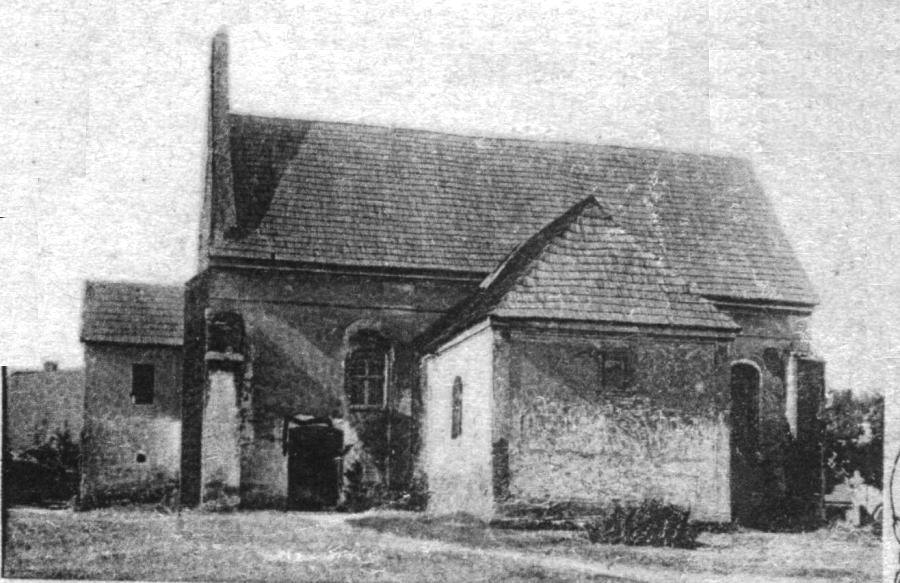
The parish church in Chrzumczütz around 1911 (renovated after the fire of 1814, photo archive Jadwiga Gryc)
Der erwähnte in dem Mittelgiebel eingemauert gewesene Tafelstein ist nach dem Brande im Jahre 1814 betrachtet und darauf die Zahl 1099 wirklich entziffert worden. Dieser Stein fiel auseinander und es sind keine Ueberreste davon vorhanden. (The tablet stone mentioned, once set into the central gable, was examined after the fire of 1814 and the number 1099 really was deciphered on it. This stone fell apart and no remains of it exist.) What significance is to be given to this date, what does the number mean in the history of our parish, asks Fr Dr Edward Szdzuj Frankiewicz OFM in his book, p. 15, “Kościół Parafialny w Chrząszczycach”.
In Alphabetisch-Statistisch-Topographische Uebersicht aller Dörfer, Flecken, Städte und andern Orte der Königl. Preuß. Provinz Schlesien, by Knie, published Breslau 1830, page 154, we read: Follwark, D. Reg. U. Kr Oppeln S 3/4. M. Königl./ Domain. U. Oppeln / O.L.G. Ratibor Königl. Domain. Just.A. Oppeln,/O.S.=/27 H. 142 E. Ganz k. K.K. zu Chrzumczütz. Muter Kirche. erbaut 1093. (Archiw Oppeln). bis zu 1810 Archd. Oppeln. Wilde Fischerei.
The question: which date is right, 1099 or 1093?
1295 Vorwerk des Gesco (the lord's), a sign of the existence of our settlement, alongside Cremchici, Zlotnici, Zlinici, near Opolini.
A Vorwerk, from the 12th century, is a large farm using the forced labour of peasants, perhaps also of the unfree (servi casati, who as such could be bought or sold, p. 116, vol. 1, “Boże Igrzyska”), whom the “Piasts” brought from their many wars with neighbours at that time. Mieszko I built the Opole stronghold from oaks felled in our Folwark forests by the Oder. Oaks, as our grandfathers recalled, which during the regulation of the River Oder (1760) and of our ditch “Moderz” still had to be pulled from the ground, where they lay deep in the marshy terrain.
Excavations on Ostrówek in Opole showed that the streets of the stronghold were paved with wood, with new roadways laid every 25 years. It was established that the town was entirely of wood. On individual beams of the Opole huts characteristic notches were found, order marks made while still in the forest, and the finished pieces were floated by water to the stronghold, where houses were built from them. The rampart of the stronghold was built as a box structure filled with earth. About 1800 cubic metres of selected oak were used for it. It should be added here that the archaeologists did not dig deeper, because the beams of houses beneath the buildings from the time of Mieszko I did not suit the Party's current policy. Work was stopped and an amphitheatre was built on the site.
In the years around 990-1335 our Silesian lands were a bone of contention; we were alternately in Poland or in Bohemia. In this period Poles and Czechs can be treated as one nation. There was a real chance, under Polish or Czech leadership, to create one strong Slavic state, but each of the two Slavic brothers meddled in the private affairs of the other. In 990 Mieszko I exploited the weakness of the Czech Přemyslids and took Silesia by force of arms. In 1003 Bolesław Chrobry took Prague and for a short time power in Bohemia. Twenty years later the Czech king paid him back in kind and carried off the body of St Adalbert from Gniezno. The testament of Bolesław Krzywousty (1138) led to the division into provinces. Silesia, the province of the eldest son Władysław II, became a bone of contention between the brothers, then their successors, some of whom paid homage to Bohemia. The division into provinces reached its height (19 separate duchies ruled by Piasts) in the years (1318-1322): fights over the succession after Henry IV with Bohemia, the kidnapping of dukes, disputes and fights between the brothers, the Piasts.
In 1335 at Trenčín and Visegrád an agreement was concluded between John of Luxembourg (ruler of Bohemia) and Kazimierz the Great (King of Poland). An agreement in which:
- John of Luxembourg renounces his claims to the Polish crown for the sum of 20 000 threescore Prague groschen in favour of Kazimierz the Great.
- Kazimierz the Great renounces acquired rights to the Silesian duchies under homage and to the Duchy of Płock in favour of John of Luxembourg.
- On 7 April the chancellery of King Charles IV issued the act of incorporation of Silesia into Bohemia. All the historical titles to these lands were gathered in it, showing that the Czech rights to these lands did not rest on Silesia having been conquered by the Bohemian Crown by force of arms and ceded by Poland. The document argued that Silesia was a Czech fief, and only through this an imperial one.
In 1335 Silesia, and so also Folwark, found itself among the lands of the “Crown of the Kingdom of Bohemia”. Did this change of state improve the lot of the inhabitants of Folwark?
That is all for today for those interested in our Folwark. In the coming months I plan to reach the present day. There are many curiosities that must be saved from oblivion.
All historical information and copied passages are taken from the bibliography:
1. Franciszek Idzikowski “Opole dzieje miasta do roku 1863”, publisher “Wydział teologiczny Uniwersytet Opolski” 2002.
2. Alicja Galas and Artur Galas “Dzieje Śląska w datach”, publisher “Rzeka”, Wrocław 2001
3. Marek Czapliński “Historia Śląska”, publisher “Uniwersytet Wrocławski”, Wrocław 2007
4. “Die Chronik Proskau” (photocopies of various pre-war publications)
5. Norman Davies “Boże Igrzyska”, publisher “Znak”, Kraków 1994
6. Zdenek Vana “Świat Dawnych Słowian”, publisher “Artia Interpres” 1985
7. Joachim Bahlcke “Schlesien und die Schlesier”, publisher “Langen Müller” 2005
8. Paweł Jasienica “Słowiański Rodowód”, publisher “PIW”, Warszawa 1978
9. Jerzy Topolski “Historia Polski”, publisher “Kopia”, Warszawa 1994
10. Maria Bretschneider “Bildstöcke”, publisher “O/S Gesellschaftsdruckerei”, Oppeln 1939
11. Karl Maurer “Oppeln”, publisher “DARI”, Berlin-Halensee 1926
12. Maria Bogucka “Dawna Polska”, publisher Wiedza Powszechna 1985
13. Aleksander Brückner “Mitologia słowiańska i polska”, publisher PWN, Warszawa 1985
14. Jerzy Mularczyk “Od Bolesława Chrobrego do Bolesława Rogatki” (polemical studies), publisher “Sudety”, Wrocław 1994
15. Klaus Ullmann “Schlesien Lexikon”, publisher “Bechtermünz”, Augsburg 1997
16. Edward Szdzuj Frankiewicz OFM “Kościół Parafialny w Chrząszczycach”, publisher św. Krzyża, Opole 1947
Greetings from Folwark, Rudolf